Innovation Lab Grants
2025-2026 Recipients

The Practice-based Artistic Archive:
Unearthing Early Black Stories in New England
Clareese Hill
College of Arts, Media and Design, Northeastern University
Elisa Hamilton
Multimedia Artist
The Practice-based archive seeks to reimagine how archives and lesser-known historical narratives can be made accessible to the public. The outcome will include a collaborative body of artwork, pedagogical materials, workshops, and a written contribution on artistic research in archives.
Biographies and Project Description
Dr. Clareese Hill is an Assistant Professor of XR and Immersive Technologies in the Art and Design Department at Northeastern University’s College of Arts, Media, and Design. She combines her background in art and research to explore identity, particularly from the perspective of an Afro-Caribbean American woman. Her interdisciplinary work uses emerging technologies to examine the validity of identity as a concept. Her scholarship extends beyond academia, with lectures and presentations in the U.S. and internationally, including England, Finland, Sweden, Australia, Ireland, and Portugal.
Dr. Hill will be collaborating with artist and researcher Elisa H. Hamilton, a socially engaged multimedia artist who creates artworks and community-centered projects that emphasize shared spaces and the hopeful examination of our everyday places, objects, and experiences. Hamilton is a 2023 Brother Thomas Fellow, and was recognized with an Honorary Doctorate by Massachusetts College of Art and Design in 2024. Her work has been shown locally and nationally in solo and group exhibitions. She has been the recipient of numerous commissions and grants to create artworks, community projects, and participatory programs.
Together, they are continuing their research project originally commissioned by Emerson Contemporary for the multiyear Un-Monument initiative with the City of Boston, investigating underrepresented narratives of Black life in early Boston. Working with the Museum of African American History (MAAH) archives in Boston and Nantucket, the project focuses on moments of non-legibility, community care praxis, and abolitionist work. Rather than emphasizing well-documented history, their research highlights the “in-between” stories—the connective tissue of the abolitionist movement.
They seek to reimagine how archives and these lesser-known narratives can be made accessible to the public. The outcome will include a collaborative body of artwork, pedagogical materials, workshops, and a written contribution on artistic research in archives. In the theme of Solidarities, they are towards resisting and preserving counter-narratives that are in the precarious wake of erasure. Collaborating with each other, institutions, and community members becomes a key strategy for refusal in the research methodology.
Additional potential archive partners include the Massachusetts Historical Society and the Boston Athenaeum, both instrumental in tracing the lives of historical figures such as Chloe Russel, Phillis Wheatley, Harriet Hayden, and the women at the Home for Aged Colored Women in the current iteration of the project.

Bridging the Expungement Gap:
Race, Gender, and Access to Clean Slate Relief in California
Sarah Lageson
School of Law, Northeastern University
The Access Project and Bay Area Legal Aid
This collaborative project brings Northeastern University together with Oakland-based legal services providers Bay Area Legal Aid and The Access Project to address racial and gender disparities in California’s criminal record expungement system.
Project Description and Biography
This collaborative project brings Northeastern University together with Oakland-based legal services providers Bay Area Legal Aid and The Access Project to address racial and gender disparities in California’s criminal record expungement system. With Dr. Sarah Lageson (School of Criminology and Criminal Justice/School of Law), the partnership will support the development and implementation of an automated tool to streamline expungement petitions, conduct original research on how race and gender affect access to Clean Slate relief, and analyze survey data from clients who have received expungement assistance. Through this work, a Northeastern student researcher will engage in community-based research while helping to identify barriers that prevent equitable access to expungement services. The project aims to strengthen both research and practice by creating sustainable partnerships between university scholars and legal aid organizations, ultimately helping Bay Area residents overcome the collateral consequences of criminal records and access new opportunities for housing, employment, and community engagement.
Sarah Lageson is a social scientist and lawyer who researches and writes about data privacy, the U.S. criminal legal system, surveillance, technology, and automation/AI. Dr. Lageson is currently an Associate Professor at the School of Criminology and Criminal Justice and the School of Law at Northeastern University, as well as an Affiliated Scholar at the American Bar Foundation. Her 2020 book, Digital Punishment: Privacy, Stigma, and the Harms of Data-Driven Criminal Justice is the recipient of the Michael J. Hindelang award, which recognizes an outstanding contribution to research in criminology and has been featured in the New York Times, the Guardian, National Public Radio’s Planet Money, WNYC’s The Takeaway, and other media outlets. Dr. Lageson’s research has been published in Criminology, Social Forces, Law and Society Review, Law and Social Inquiry, Punishment & Society, the Annual Review of Criminology, and the Harvard Journal of Law and Technology, among other outlets. Her public writing about issues related to law and technology has appeared in the Washington Post, Wired, Slate, Vice, The Appeal, San Francisco Chronicle, and The Conversation. She received a PhD in Sociology from the University of Minnesota and a JD from Rutgers Law School, where she interned at the New York Office of the Appellate Defender and the New York Legal Assistance Group’s Pro Se Clinic at the Southern District of New York, and the Rutgers Expungement Law Project. Before academia, Dr. Lageson was an Americorps VISTA and worked in the nonprofit sector.
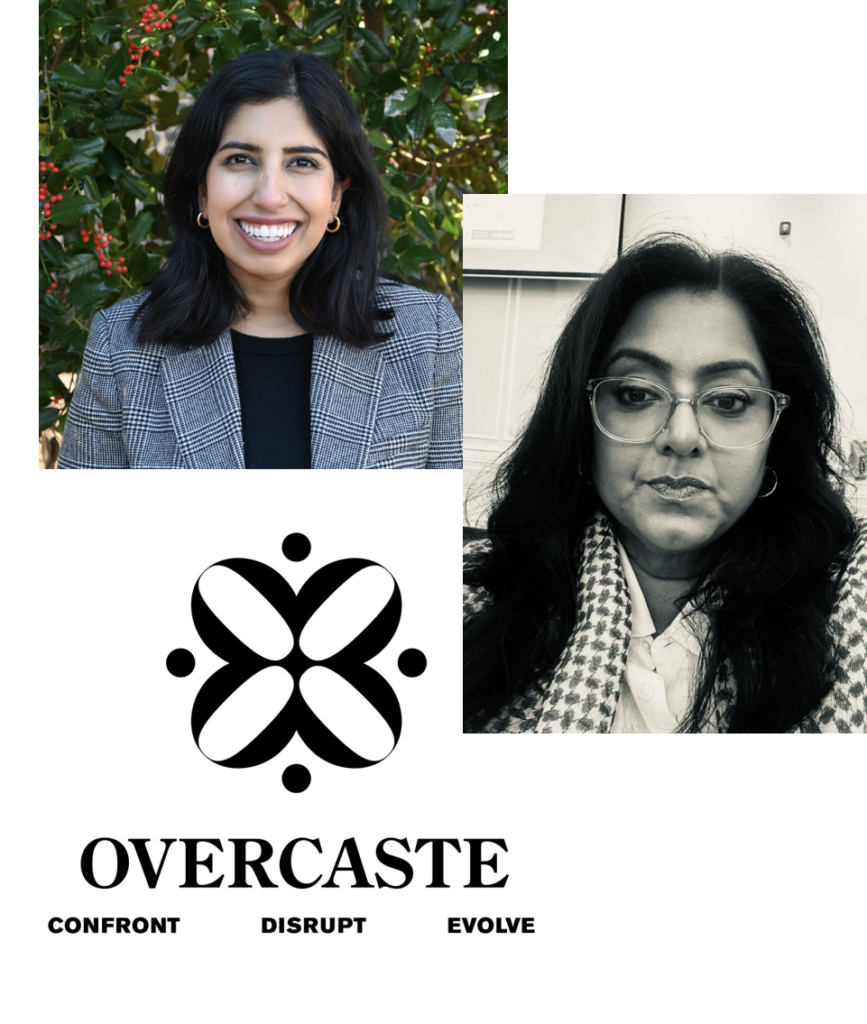
Exhibiting “OVERCASTE:
Confront, Disrupt, Evolve” in the U.S.
Sasha Sabherwal
College of Social Science and Humanities, Northeastern University
Anita Lal
Director, Poetic Justice Foundation and co-curator, Overcaste
OVERCASTE creates space for building coalitional solidarities and relationships between university-based scholars and grassroots organizers, between South Asian communities and broader racial justice movements, and between those with institutional privilege and those often excluded from formal knowledge production.
Project Description and Biography
In March 2024, OVERCASTE, an anti-caste exhibit, premiered in Burnaby, British Columbia, Canada where it was met with overwhelming community engagement. The exhibit ignited crucial public conversations around caste discrimination, complicity, and the possibilities for solidarity across lines of caste, gender, sexuality, and nation. Caste is a violent system of social hierarchy originating in South Asia that classifies people by birth and assigns social value based on hereditary occupation. Though often linked with Hindu religious traditions, caste operates across multiple religious and regional contexts and continues to structure social life in both South Asia and its diasporas. Through visual art, oral histories, and archival materials, OVERCASTE centers the voices and lived experiences of Punjabi Sikh Dalits (caste-oppressed people) in the Canadian diaspora and explores how caste continues to structure diasporic South Asian life. Framed by Dalit leader and chief architect of the Indian constitution Dr. B.R. Ambedkar’s radical call to “Educate, Agitate, Organize,” the exhibit insists on caste abolition as a political and ethical project. It rejects liberal appeals to reform and instead foregrounds the structural dismantling of cultural norms, institutions, and knowledge systems that uphold caste. In doing so, it asks: What can anti-caste praxis look like in the diaspora, and what solidarities are possible when caste is understood as a transnational, gendered, and intersectional form of violence? OVERCASTE creates space for building coalitional solidarities and relationships between university-based scholars and grassroots organizers, between South Asian communities and broader racial justice movements, and between those with institutional privilege and those often excluded from formal knowledge production. The project moves beyond extractive models of collaboration and instead invests in relationships rooted in mutual accountability and shared vision.
Anita Lal is a fourth-generation settler living on the traditional lands of the Semiahmoo, Katzie, Kwikwetlem, Kwantlen, Qayqayt, and Tsawwassen First Nations, also known as Surrey, BC, Canada. Her great-grandfather Maiya Ram Mahmi was documented as the first Dalit to come to North America in 1906. Her grandmother, Thakuri Kaur Lal, instilled in her the Sikh values of seva and social justice. As co-founder of Poetic Justice Foundation, Anita creates inclusive, intersectional programming focused on addressing casteism, racism, and discrimination. She co-curated the groundbreaking anti-caste exhibit, OVERCASTE: Confront. Disrupt. Evolve. Anita serves on boards including Arts BC, Women Transforming Cities, and the advisories for South Asian Studies Institute at the University of the Fraser Valley, Seva Foundation, Punjabi Canadian Legacy Project, Royal Academy of Punjab and is the Director of Operations and EDI at Moving Forward Family Services. Inspired by Dr. Ambedkar, she believes in the power to “Educate. Agitate. Organize.”
Sasha Sabherwal (she/her) is an interdisciplinary scholar of the South Asian diaspora with research interests in ethnic studies, the racialization of religion, transnational gender and sexuality studies, and the intersections of caste and race. She is Assistant Professor of Cultural Anthropology and Global Asian Studies at Northeastern University. She holds a PhD from Yale University in the Department of American Studies with a certificate in Women’s, Gender, and Sexuality Studies. Her research examines caste and gender hierarchies in the Sikh diaspora of the Pacific Northwest. She explores how caste is reproduced and how it becomes a heterogeneous and flexible category. The project demonstrates that as caste travels, it oscillates between traditional caste hierarchies from the homeland and contemporary diaspora. Her scholarly and public-facing work can be found in Journal for Asian American Studies, Social Text, Sikh Formations, Sikh Research Journal, and Anthropological Quarterly.

Middle School, Experiential Learning, and Careers: Connecting STEM, Teachers, and Industry Partners for Workforce Development
Corliss Thompson
College of Professional Studies, Northeastern University
Ellen Stoddard
College of Professional Studies, Northeastern University
Tiana Yom
College of Professional Studies, Northeastern University
Richard Cox
STEM Program Coordinator at Advocate Health
This project lays the foundation for a Charlotte-based STEM education research partnership. In collaboration with the community, we aim to tackle Charlotte’s economic mobility challenges through solidarity-centered approaches to STEM education, profession-based, experiential learning, and collaboration with industry.
Project Description and Biography
Middle School, Experiential Learning, and Careers: Connecting STEM Learning, Teachers and Industry Partners for Charlotte Workforce Development
This project lays the foundation for a research partnership between Northeastern University and the Atrium Health, now part of Advocate Health, Charlotte STEM Lab, opening in the Pearl, Charlotte’s Innovation District, Winter/Spring 2026. Together, we aim to tackle Charlotte’s economic mobility challenges through solidarity-centered approaches to STEM education, profession-based, experiential learning, and collaboration with industry.
The initiative focuses on three key goals:
1. Building a Strong Research Foundation
Our team will conduct a thorough review of research on career development, learning environments, and hands-on, profession-based experiences. This work will guide the creation of a clear, evidence-informed framework tailored to Charlotte, using Social Cognitive Career Theory and the Social Ecological Model to shape our approach.
2. Developing a Community Partnership Framework
We are committed to co-creating this work with our partners. This includes designing a mixed-methods research plan that uses culturally responsive evaluation, holding virtual planning sessions and site visits, and hosting a half-day Profession-Based Learning Think Tank. These efforts will ensure community voices help shape the partnership’s direction and priorities.
3. Laying the Groundwork for Long-Term Impact
We will also create a detailed logic model and review evaluation tools to support future research and funding efforts. These foundational pieces will help us build a strong, lasting structure for studying how real-world learning experiences can improve economic mobility and increase access to STEM careers in Charlotte.
Dr. Corliss B. Thompson is Associate Dean of the Graduate School of Education at Northeastern University’s College of Professional Studies and Teaching Professor of Education. Her research and administrative work focus on teaching and learning and its connection to career pathways for all students, especially those from marginalized backgrounds. Dr. Thompson has experience in academic organizational leadership as well as academic-industry partnership development. Her previous work, supported by an NSF-ITEST exploratory grant, examined how experiential learning programs support student motivation and preparation for STEM careers, with particular attention to increasing participation of female and underrepresented students.
Dr. Ellen W. Stoddard brings expertise in experiential learning in STEM pathway programs, grounded in social cognitive career theory and experiential learning theory, to the research team. She holds an Ed.D. in Curriculum, Teaching, Leadership and Learning from Northeastern University, where her dissertation examined women STEM professionals’ transitions to project-based teaching. Dr. Stoddard has served on research teams for two NSF awards: #2148543 “African American Young Women in Making to Engage in STEM and Entrepreneurship” (AAMASE), funded by NSF’s Innovative Technology Experiences for Students and Teachers program, and #1850072 “Impact of High School STEM Projects on Student Motivation and Preparation for STEM Careers.”
As Director of Cooperative Education at Northeastern University’s College of Professional Studies, she built an experiential learning program serving 400+ students annually while collaborating with faculty across 30+ programs to integrate experiential learning into curricula. She currently teaches two graduate courses at Northeastern University’s Graduate School of Education and is the founder of Fairlead Education Consulting.
Dr. Tiana Yom is an accomplished evaluation researcher and strategic leader with over 15 years of experience in mixed-methods research, youth development, and cross-sector collaboration. She holds an Ed.D. in Health Behavior Studies from Teachers College, Columbia University, and has secured over $2.5 million in research funding from federal, philanthropic, and private-sector partners. Dr. Yom previously served as an Assistant Research Professor and Director of the Northeastern University Public Evaluation Lab, where she led more than 65 community–academic partnerships grounded in culturally responsive evaluation practices. She is the Founder and Principal of Counter Narratives Group LLC, where she directs evaluation consulting, educational program design, and applied research initiatives with organizations across public, nonprofit, and private sectors. At Counter Narratives Group, Dr. Yom helps organizations challenge traditional data narratives by embracing complexity and diverse perspectives, enabling them to develop strategies rooted in trust, transparency, and rigor. Her work supports informed decision-making that drives meaningful, system-level change.
Dr. Richard Cox, Jr. is the STEM Program Coordinator at Advocate Health, based in Charlotte, North Carolina. In this role, he supports STE(A)M education initiatives for the enterprise, focusing on programming and outcomes for K-8 learners through work at The Pearl Innovation District in Charlotte (www.thepearlclt.com) and Innovation Quarter in Winston-Salem. With over 15 years of research and hands-on experience in transdisciplinary and integrated learning, Dr. Cox has championed STEAM education across diverse settings, from Kentucky to Chicago to North and South Carolina, engaging learners of all ages. Dr. Cox holds a Doctorate in Education and Social Change, specializing in mathematics, science, and transdisciplinary STEAM approaches. Richard has experience as a faculty member, classroom teacher, K-12 Instructional Coach, and STEAM Lab Coordinator, enabling him to bridge traditional teaching with imaginative approaches. His research focuses on imaginative learning, STEAM career pathway development, and workforce readiness, making him a thought leader in preparing learners for dynamic futures. His unique combination of practical experience, academic research, and leadership in professional development ensures that his contributions to this book are both deeply insightful and broadly impactful.